
Eighth Amendment to the Goods and Services Tax Act: Major Changes to the Maldives GST Regime
September 18, 2026

On 31 August 2026, the Eighth Amendment to the Goods and Services Tax Act (the “Amendment”) was ratified and published in the Government Gazette, bringing significant changes to the Maldives GST regime.
Key Amendments:
- Revised definitions of goods and services
- New place of supply rules
- Adoption of the destination principle
- New requirements relating to tax invoices and time of supply
- Expansion of GST exemptions
1. Revised definitions of goods and services
| Term | Previous | Amended | Key Impact |
| Goods | Goods referred to goods sold by a business conducted in the Maldives. Excluded: (i) rights or interests arising under law or contract; and (ii) money. |
Goods now mean all tangible movable and immovable goods. Excluded: (i) money; and (ii) products transmitted electronically by wire, cable, radio, optical, electromagnetic, or similar systems. | The exclusion for rights and interests arising under law or contract has been removed, potentially broadening the range of transactions that may fall within the GST regime. |
| Services | Services mean anything that is not goods. | Services continue to mean anything that is not goods, but money is now expressly excluded from the definition. | Provides greater certainty by expressly excluding money from the definition of services. |
2. New place of supply
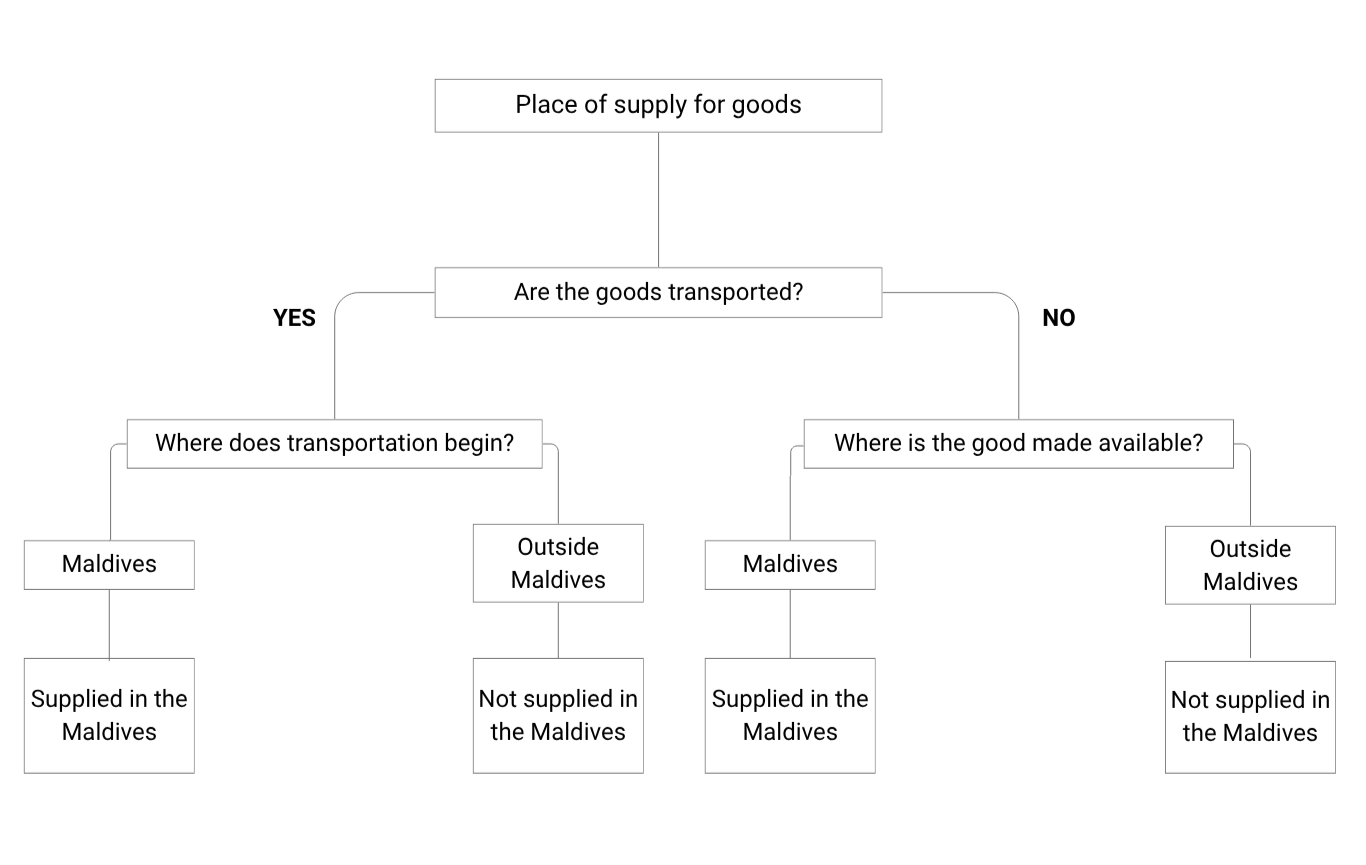
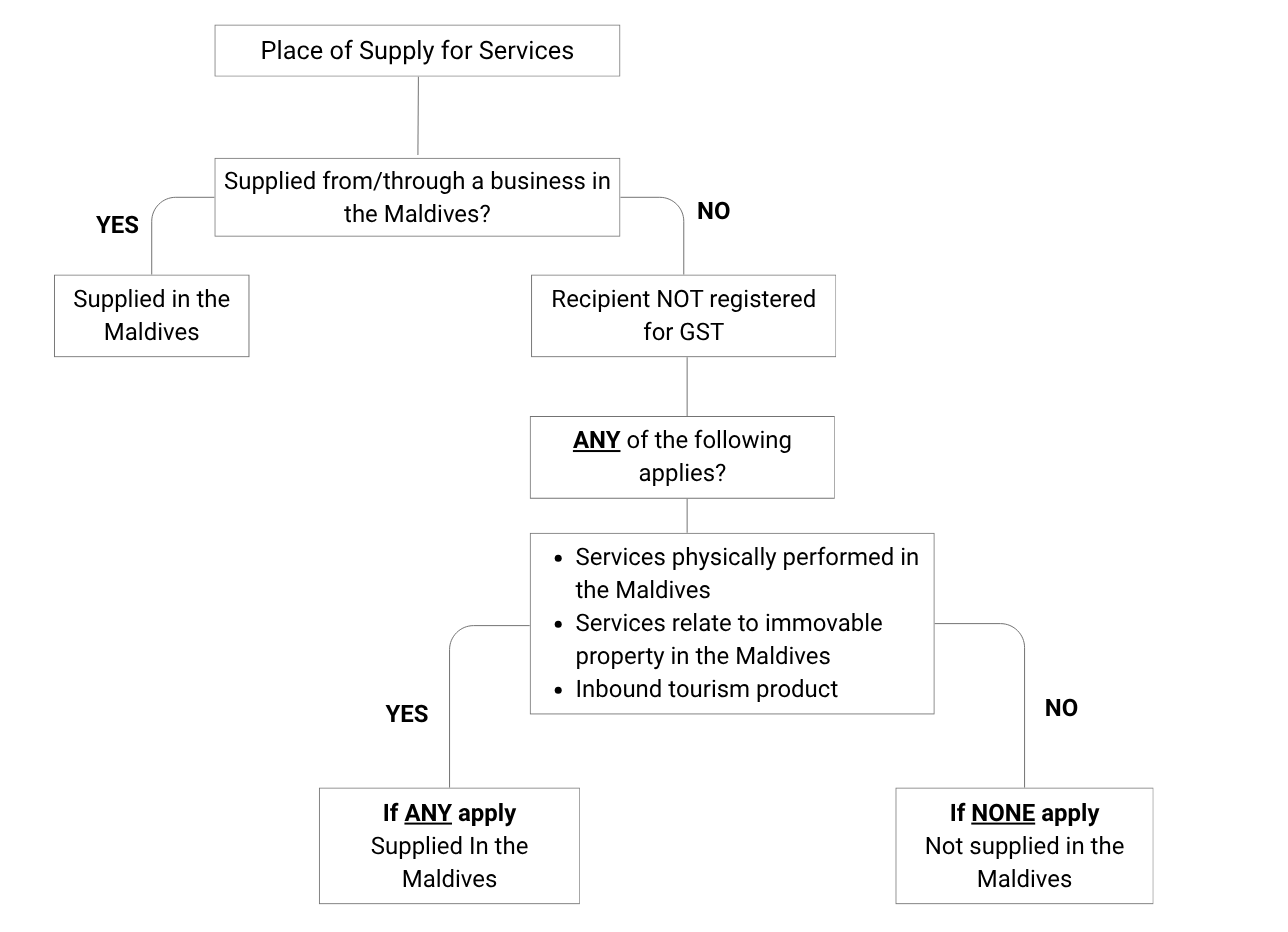
In line with the shift to the destination principle, the Amendment introduces new rules for determining whether a supply of goods or services takes place in the Maldives.
3. Implementing the Destination Principle
One of the most notable changes introduced by the Amendment is the adoption of a destination-based taxation model under which tax is imposed in the jurisdiction where a service is consumed, regardless of whether the supplier has a physical presence or is established overseas.
Inbound Tourism
Under the Amendment, supplies of inbound tourism products in the Maldives by persons who do not have a fixed place of business in the Maldives will fall within the tourism sector for GST purposes. The Amendment defines an ‘inbound tourism product’ broadly, covering accommodation, food, transportation, and other tourism-related activities operated in the Maldives. This requirement brings foreign tour operators and travel agencies that sell or arrange Maldives tourism products within the Maldivian GST framework, even if they do not have a physical presence in the Maldives. Such suppliers are to be taxed from 1 October 2026.
Value of Supply
The Amendment does not result in GST being imposed twice on the same tourism product. Instead, the value of supply, including GST of an inbound tourism product by persons who do not have a fixed place of business in the Maldives would be:
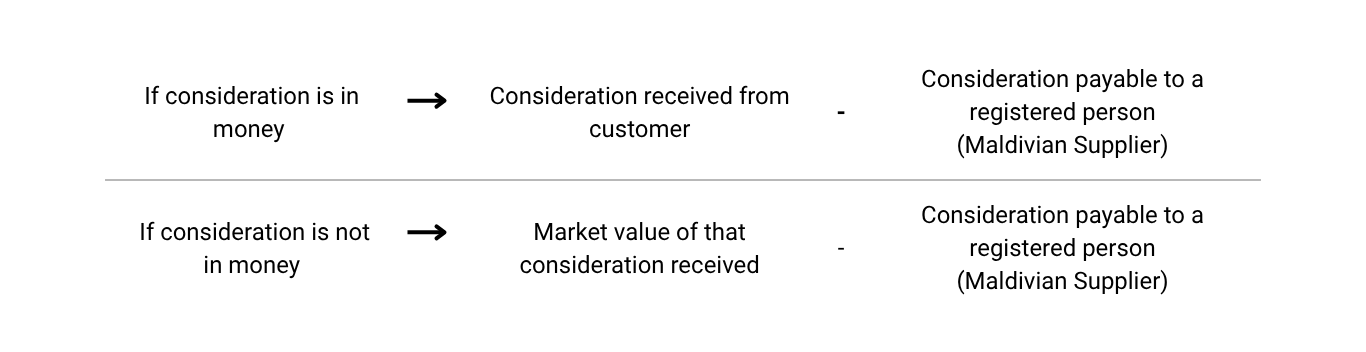
As a result, GST is effectively applied only to the value added by the offshore supplier, such as its margin or commission. Consistent with this treatment, suppliers operating under this regime are not entitled to claim input tax deductions.
To illustrate, assume a Maldives resort sells a three-night full board holiday package to a tour operator based in Europe for USD 1,500. The European tour operator then markets and sells the package to a traveller for USD 1,850. Under the new regime, the European tour operator is not liable to pay GST on the full USD 1,850 paid by the traveller. Instead, the taxable value (inclusive of GST) is based on the USD 350, difference between the amount paid to the resort and the amount charged to the traveller. In effect, the rules seek to tax the value added by the overseas intermediary, rather than imposing GST a second time on the underlying tourism services already supplied by the Maldivian resort.
| Details | USD |
| Amount paid by Traveller | 1,850.00 |
| Less: Amount Paid to Resort | (1,500.00) |
| Value of supply for the Tour Operator | 350.00 |
| Net Consideration ( A / 117 x 100 ) | 299.15 |
| GST Payable ( A /117 x 17 ) | 50.85 |
4. Tax Invoices and Time of Supply
The Amendment incorporates the existing three-day invoicing requirement from the GST regulation directly into the GST Act with more clarification. Under amended Section 17, a registered person must issue a tax invoice or receipt within three days in the following circumstances:
- For supplies of goods:
- Where goods are removed from the place of supply – the three-day period begins when the goods are removed from the place of supply.
- Where goods are not removed from the place of supply – the three-day period begins when the goods are made available to the recipient.
- For supplies of services, the three-day period begins from completion of all services supplied. The Amendment also introduces a deeming provision under which, where a taxable person fails to issue an invoice within the prescribed three-day period, the invoice will be treated as having been issued on the date the three-day period expires. This prevents businesses from postponing GST reporting obligations through delayed invoicing.
5. New GST exemptions
The Amendment also expands the list of GST-exempt supplies. The newly added exemptions are:
- Waste management services – provided that they are supplied by a person holding a license under the Waste Management Act.
- Goods and services supplied to a state office, institution, or State-Owned Enterprise (SOE) – for a project under a loan or grant agreement with foreign governments, foreign financial institutions, or international organisations and to the extent that the agreement contains explicit provisions granting exemption from GST.
Contractors undertaking such projects will not be entitled to claim input tax deductions in respect of costs incurred in making these exempt supplies.
Summary
Overall, the Eighth Amendment is a significant milestone in the development of the Maldives GST system and reflects a broader shift towards taxing consumption where it occurs. While the changes are particularly relevant to the tourism industry and offshore suppliers involved in the sale of Maldives tourism products, their impact extends beyond the sector through the introduction of new place of supply rules and other amendments. The implementation of the new framework is also supported by the introduction of GST registration procedures for foreign suppliers of inbound tourism supplies, with MIRA now facilitating registration through its online portal and issuing TINs and MIRAconnect credentials to eligible applicants. As the new provisions come into effect, businesses should carefully review their transactions, contractual arrangements, invoicing practices, and compliance processes to ensure they are prepared for the amended GST framework.
It is advisable to seek professional guidance to ensure compliance and mitigate potential risks. If you have any questions relating to GST and other accounting and tax related matters, please email us at [email protected]
Article Contributors
Fathimath Milna Ahmed, Associate
Aminath Leen Lizam, Principal Associate
